Denver's elevation of 5,280 feet creates thinner air with lower atmospheric pressure, requiring altitude-calibrated cooling equipment to achieve proper heat rejection and airflow. A standard central air conditioner…
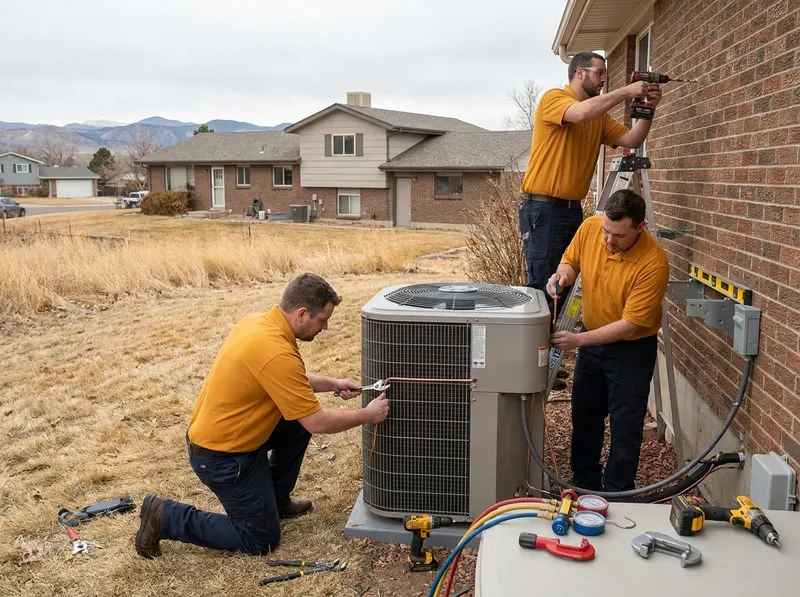
Denver's elevation of 5,280 feet creates thinner air with lower atmospheric pressure, requiring altitude-calibrated cooling equipment to achieve proper heat rejection and airflow. A standard central air conditioner installation is ideal for Denver County properties with existing forced-air duct systems, providing whole-home climate management through a single centralized thermostat. For properties lacking functional ductwork—such as historic brick bungalows in Baker or classic Victorians in Five Points—a ductless mini-split system serves as a practical alternative, avoiding intrusive structural modifications. Choosing central cooling balances whole-house comfort and lower upfront equipment costs against the necessity of clean, well-sealed duct distribution.
Outdoor condensers in neighborhoods like Washington Park, Congress Park, and Capitol Hill face intense summer sun and high ambient afternoon temperatures, demanding accurate sizing rather than rough guesswork. Over-sizing an air conditioning unit leads to short-cycling and uneven cooling, while under-sizing causes the compressor to run continuously during July heatwaves near City Park and Cherry Creek. In newer builds across Central Park and established homes in Park Hill or Sloan's Lake, technicians calculate exact indoor sensible heat gain to pair matching coils and line sets. Every installation accounts for city permitting standards and local electrical requirements so your cooling investment performs safely under heavy thermal loads.
Every job gets a firm, written price after a free on-site visit.
Tell us about your central air conditioner installation job in Denver and we'll send a clear, written quote — usually the same day.
 Enterprise HVAC Solutions